

High-value equipment can look perfectly protected on the outside while moisture quietly creates problems inside the package.
During transportation and storage, sensitive machinery, electronics, semiconductor tools, aerospace components, medical devices, and industrial equipment may encounter humidity, condensation, temperature changes, contaminants, and long transit times.
That is why companies use vapor barrier packaging to create a sealed protective environment around equipment before it moves.
Vapor barrier packaging uses multilayer barrier materials, sealing methods, and moisture-control components to help reduce moisture and air exchange around sensitive assets. Crating Technology integrates these systems with custom crating and industrial packaging solutions for demanding domestic, export, and long-term storage applications.
Here are seven reasons vapor barrier packaging matters when the equipment inside the shipment cannot afford moisture-related damage.
1. Moisture Can Cause Damage Before Anyone Sees It
A shipment does not need to be directly exposed to rain for moisture to become a problem.
Equipment can encounter:
- High humidity
- Condensation
- Temperature fluctuations
- Ocean freight conditions
- Long storage periods
For metal components and sensitive electronics, that exposure can contribute to corrosion, rust, electrical problems, coating damage, and reduced equipment reliability.
Vapor barrier packaging helps isolate sensitive equipment from external moisture and atmospheric conditions by creating a sealed protective enclosure.
2. It Protects What a Wooden Crate Alone Cannot
A custom wooden crate is excellent for structural protection, blocking, bracing, and resistance to transportation impacts.
But structural protection and moisture protection are not the same thing.
Vapor barrier packaging works inside the overall packaging system to create an additional defense against:
- Humidity
- Water vapor
- Dust
- Atmospheric contaminants
- Corrosion risks
This allows the crate and the internal barrier to perform different jobs: the crate protects against physical transportation hazards, while the vapor barrier helps control the environment surrounding the equipment. Crating Technology uses this combined approach for moisture-sensitive industrial and export shipments.
3. Export Shipping Can Put Equipment Through Extreme Conditions
International transportation can be especially challenging for moisture-sensitive equipment.
A shipment may spend weeks moving through:
- Ocean freight environments
- Ports and staging areas
- Warehouses
- Different climates
- Multiple transportation modes
Changes in temperature and humidity can increase the possibility of condensation and corrosion.
For this reason, vapor barrier packaging is particularly valuable for export crating, where equipment may remain sealed for extended periods before reaching its final destination.
4. Desiccants Add Another Layer of Moisture Control
Sealing equipment inside a barrier is only part of the protection strategy.
Residual moisture can remain inside the enclosure, which is why vapor barrier systems may also incorporate desiccants.
Desiccants absorb moisture remaining within the sealed environment and help maintain lower humidity levels around sensitive equipment.
Crating Technology’s vapor barrier solutions can incorporate desiccants along with heat-sealed closures and other moisture-control methods to provide additional protection during transit and storage.
5. Vapor Barrier Packaging Is Useful for Storage Too
Not every piece of equipment is unpacked immediately after delivery.
Machinery and components may remain stored while companies wait for:
- Installation
- Facility completion
- Production schedules
- Project deployment
- Replacement needs
During that time, environmental conditions may continue to change.
Vapor barrier packaging can help preserve equipment during extended storage by limiting exposure to humidity, dust, and contaminants. This makes it useful not only for transportation but also for equipment preservation before commissioning or installation.
6. Some Industries Have Much More to Lose From Moisture
Vapor barrier packaging is especially relevant when equipment is expensive, sensitive, difficult to replace, or critical to operations.
Semiconductor Manufacturing
Semiconductor tools and electronic systems can require protection against moisture, contamination, and environmental changes. Crating Technology has used vapor barrier systems as part of packaging solutions for semiconductor equipment moving through ocean transit.
Aerospace and Defense
Precision components and defense equipment may require controlled preservation methods and moisture-resistant packaging. Barrier materials, desiccants, and sealed packaging systems can be part of those requirements.
Medical Equipment
Sensitive medical systems can benefit from packaging that reduces corrosion and contamination risks during transportation and storage.
Industrial and Energy Equipment
Heavy machinery, fabricated components, and specialized industrial systems can require moisture control when moving internationally or remaining in storage for extended periods.
7. Preventing Damage Can Be Less Costly Than Fixing It
Moisture-related damage does more than affect the equipment itself.
It can lead to:
- Repair work
- Replacement costs
- Installation delays
- Production downtime
- Missed project schedules
- Additional freight and handling expenses
For high-value assets, packaging should be part of the overall risk-management strategy.
Vapor barrier packaging helps reduce exposure to conditions that can contribute to corrosion and moisture-related damage, protecting the equipment before those problems have an opportunity to develop.
What Is Vapor Barrier Packaging?
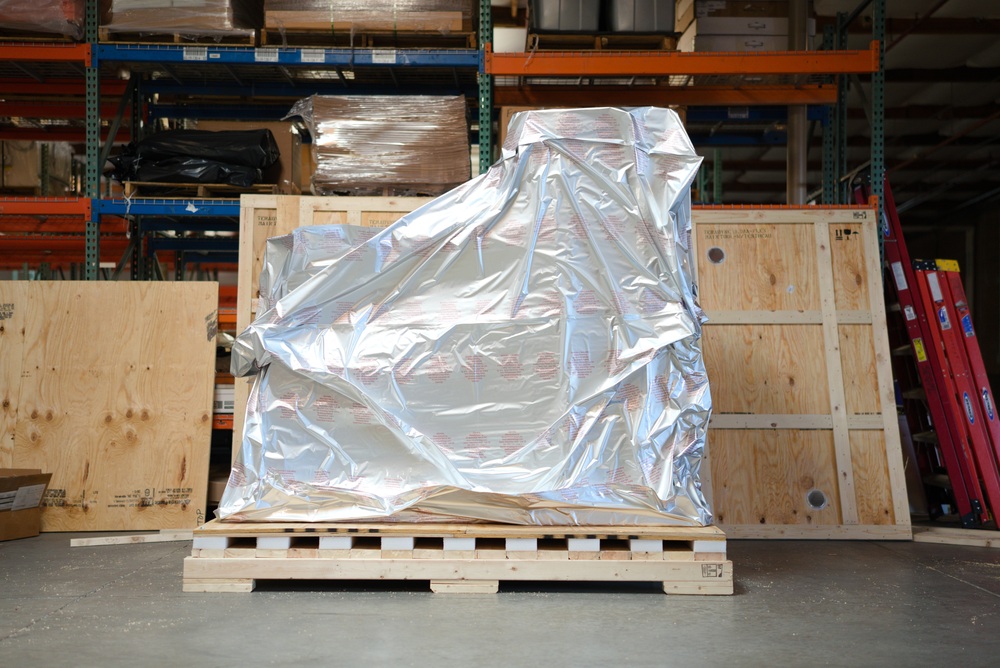
Vapor barrier packaging is a sealed industrial packaging system designed to limit moisture and air exchange between sensitive equipment and the surrounding environment during shipping or storage.
These systems commonly use multilayer barrier films. Depending on the application, the protective enclosure can also include:
- Heat-sealed seams
- Desiccants
- Humidity indicators
- Vacuum-assisted sealing
- Corrosion-control materials
- Custom external crating
Crating Technology uses vapor barrier packaging alongside engineered crating and industrial packaging services to create complete protective systems for sensitive and high-value assets.
How Does Vapor Barrier Packaging Work?
Step 1: Evaluate the Equipment
The packaging requirements are determined by factors such as:
- Equipment dimensions
- Weight
- Materials
- Moisture sensitivity
- Transportation method
- Expected storage period
- Environmental conditions
Understanding these variables helps determine how the barrier system should be configured.
Step 2: Prepare the Equipment
Before sealing, the equipment is properly positioned and protected.
Depending on the shipment, preparation may include:
- Blocking and bracing
- Custom foam
- Protective cushioning
- Anti-static materials
- Surface protection
Step 3: Install the Vapor Barrier
A barrier material is fitted around the equipment and sealed to create a controlled enclosure.
Crating Technology uses customizable barrier solutions designed to fit equipment of different sizes and shapes, with durable sealing methods intended for demanding transit and storage conditions.
Step 4: Add Moisture-Control Materials
Desiccants may be placed inside the sealed enclosure to absorb residual moisture.
Humidity indicators may also be included when the shipment requires an easy way to monitor moisture conditions inside the package.
Step 5: Integrate the Barrier With Custom Crating
Once protected internally, the equipment can be secured inside an engineered crate.
The resulting system can combine:
- Structural support
- Blocking and bracing
- Shock protection
- Moisture protection
- Export-ready packaging
For some demanding export applications, vapor barrier packaging may also be used inside a custom crate while heat shrink wrapping provides additional weather protection around the exterior.
Vapor Barrier Packaging vs. Standard Packaging
| Standard Packaging | Vapor Barrier Packaging |
| Primarily provides general physical protection | Adds dedicated moisture and environmental protection |
| Limited control over humidity | Creates a sealed protective enclosure |
| Suitable for routine shipments | Designed for moisture-sensitive equipment |
| May not address corrosion risks | Can incorporate desiccants and corrosion-control methods |
| Often intended for shorter transport cycles | Suitable for export transit and extended storage |
When Should You Use Vapor Barrier Packaging?
Vapor barrier packaging should be considered when equipment:
- Is sensitive to moisture or corrosion
- Contains electronics or precision components
- Will travel by ocean freight
- Will be stored for an extended period
- Is moving through changing climates
- Has high replacement or repair costs
- Requires additional preservation beyond standard crating
The correct protection system depends on the equipment itself, its destination, how long it will remain packaged, and the conditions it may encounter along the way.
Vapor Barrier Packaging and Export Crating
For international shipments, vapor barrier protection is often most effective when integrated into a complete export packaging system.
A typical solution may combine:
- Equipment preparation
- Custom blocking and bracing
- Vapor barrier protection
- Desiccants or humidity monitoring
- Engineered custom crating
- Additional exterior protection when needed
Crating Technology combines moisture-control materials with engineered export crating, foam fabrication, shock protection, heat-treated wood, and other industrial packaging methods depending on shipment requirements.
Why Choose Crating Technology for Vapor Barrier Packaging?
Crating Technology provides custom vapor barrier packaging for high-value and moisture-sensitive industrial equipment.
Rather than treating moisture protection as an isolated wrapping step, the company can integrate vapor barrier protection into a broader packaging system that includes:
- Custom engineered crates
- Industrial packaging
- Blocking and bracing
- Foam protection
- Export packaging
- Heat shrink wrapping
- Moisture-control solutions
Its vapor barrier services are designed for applications involving electronics, semiconductor equipment, aerospace and defense components, medical devices, oil and gas machinery, and other sensitive industrial assets.
Frequently Asked Questions About Vapor Barrier Packaging
What is vapor barrier packaging used for?
Vapor barrier packaging is used to protect moisture-sensitive equipment from humidity, condensation, corrosion, and environmental contaminants during transportation and storage.
How does vapor barrier packaging prevent moisture damage?
The equipment is enclosed within a low-moisture-permeability barrier material that is sealed to reduce moisture and air exchange with the surrounding environment. Desiccants may also be placed inside to absorb residual moisture.
Is vapor barrier packaging suitable for international shipping?
Yes. Vapor barrier packaging is particularly useful for export shipments because equipment can experience long transit periods, changing climates, ocean freight conditions, and extended storage before delivery.
Can vapor barrier packaging be combined with a custom crate?
Yes. Vapor barrier packaging can be installed around sensitive equipment and then incorporated into a custom engineered crate. The barrier addresses moisture exposure while the crate provides structural protection against transportation forces.
What equipment benefits from vapor barrier packaging?
Semiconductor tools, electronics, aerospace components, defense equipment, medical devices, industrial machinery, and other high-value or corrosion-sensitive assets can benefit from vapor barrier protection.
Are desiccants used with vapor barrier packaging?
They can be. Desiccants are commonly incorporated inside sealed vapor barrier systems to absorb residual moisture and provide an additional level of humidity control.
What is the difference between vapor barrier packaging and heat shrink wrapping?
Vapor barrier packaging is designed primarily to control moisture exposure around sensitive equipment. Heat shrink wrapping is generally used as an exterior protective covering against weather, dust, and handling exposure. For demanding shipments, both methods can be used within the same packaging system.
Protect Sensitive Equipment With Vapor Barrier Packaging
When moisture, corrosion, and environmental exposure could compromise valuable equipment, standard packaging may not provide enough protection.
Crating Technology provides vapor barrier packaging solutions that can be customized around the equipment, transportation method, storage conditions, and protection requirements of each project.
Whether you are preparing semiconductor equipment for ocean freight, preserving industrial machinery for long-term storage, or shipping precision components internationally, a properly designed vapor barrier packaging system can help keep your equipment protected from origin to destination.
Contact Crating Technology to discuss a vapor barrier packaging solution designed for your shipment.


