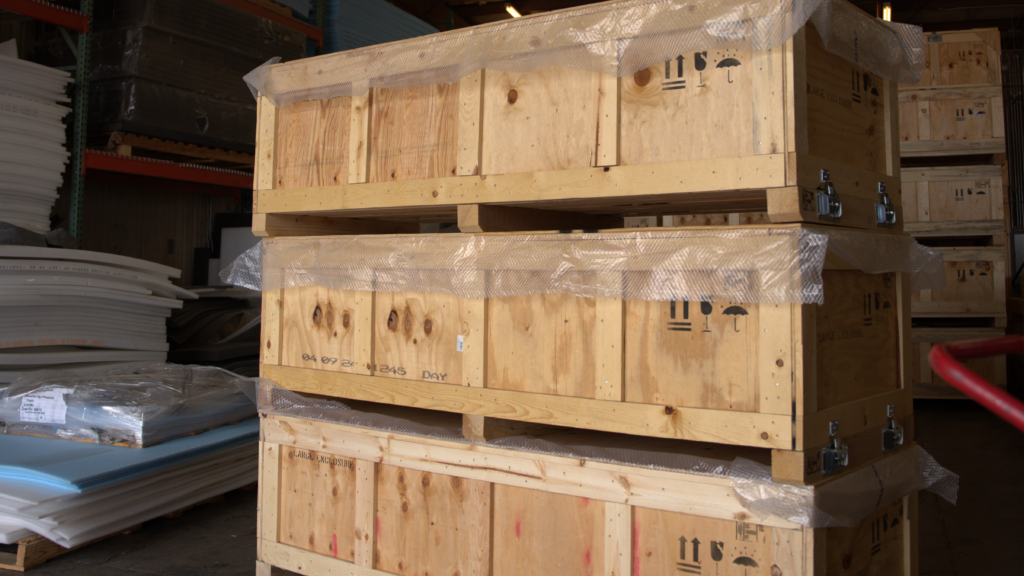

Crating Technology specializes in multi-component shipment crating solutions designed for industrial equipment, machinery, electronics, and complex assemblies that require organized packaging, component protection, and efficient deployment.
Unlike standard packaging solutions, multi-component shipments require a structured approach to ensure every part arrives protected, identified, and ready for installation.
Our custom crating systems are engineered around the specific requirements of each shipment, including component size, weight distribution, handling conditions, transportation method, and receiving process.
From custom foam inserts and labeled compartments to reinforced crates and coordinated packaging systems, we help companies protect valuable equipment throughout the entire shipping process.
What Are Multi-Component Shipment Crating Solutions?
Multi-component shipment crating is a specialized packaging approach designed for shipments containing multiple parts, assemblies, accessories, tools, and supporting components that must arrive together.
These shipments are common in industries where equipment consists of several interconnected pieces that require proper organization during transportation.
Examples include:
- Industrial machinery systems
- Semiconductor equipment assemblies
- Medical device systems
- Aerospace components
- Automation equipment
- Manufacturing systems
- Electronic assemblies
- Replacement modules and accessories
Unlike single-item shipments, multi-component shipments require more than structural protection. They require a packaging strategy that supports identification, handling, installation, and inventory control.
Why Complex Shipments Need Specialized Crating
When multiple components are shipped together without proper organization, companies can experience:
- Missing parts during receiving
- Incorrect installation sequence
- Increased unpacking time
- Component damage
- Difficult inventory verification
- Project delays
- Additional handling costs
A properly engineered multi-component crate creates a dedicated location for each item while protecting components from movement, vibration, impact, and environmental exposure.
Multi-Component Shipping Challenges and Solutions
| Shipping Challenge | Multi-Component Crating Solution |
| Multiple loose components | Custom compartments and organized placement |
| Different component sizes | Custom inserts and dedicated sections |
| Sensitive equipment | Foam protection and vibration control |
| Difficult receiving process | Labels, identification systems, and packing documentation |
| Complex installation sequence | Layered packaging and planned unpacking order |
| Multiple crates in one project | Coordinated crate identification and documentation |
The goal is not only to protect equipment during transportation, but also to make receiving and installation more efficient.
Our Multi-Component Crating Process
Every project begins with understanding the equipment, components, and final shipping requirements.
1. Shipment Assessment and Planning
Before building a crate, our team reviews the requirements of the shipment, including:
- Number of components
- Equipment dimensions
- Weight distribution
- Fragility requirements
- Center of gravity
- Transportation method
- Handling requirements
- Installation sequence
This evaluation allows us to determine the most effective crate configuration.
2. Component Organization and Traceability
Organization is one of the most important factors in multi-component shipments.
Our solutions can include:
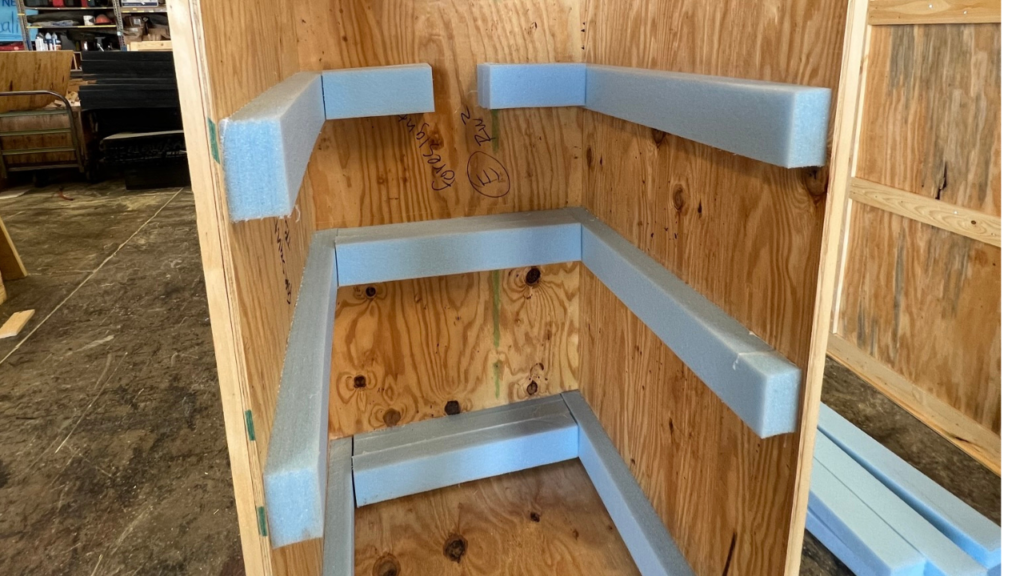
- Custom foam inserts
- Individual component compartments
- Color-coded identification
- Durable ID labels
- Tool and accessory locations
- Master packing lists
- Component tracking systems
These features help receiving teams quickly identify each item and reduce confusion during unpacking.
3. Custom Foam Inserts and Protective Packaging
Different components require different levels of protection.
Custom inserts can be designed to:
- Prevent movement inside the crate
- Protect sensitive surfaces
- Reduce vibration impact
- Maintain component positioning
- Simplify removal and installation
For sensitive equipment, foam solutions can be combined with additional protective packaging such as anti-static materials, moisture protection, and vibration control systems.
Crating Technology also provides custom foam packaging solutions for specialized equipment protection.
4. Structural Crate Design and Securement
The external crate structure protects the complete shipment during transportation.
Depending on the project, solutions may include:
- Heavy-duty wooden crates
- Reinforced framing
- Internal blocking
- Bracing systems
- Custom skids
- Shock protection
- Specialized lifting points
Each crate is designed according to the actual shipment requirements rather than using a standard packaging format.
How We Protect Different Components Within One Shipment
Multi-component shipments often include parts with different levels of sensitivity.
For example:
- Heavy components may require reinforced supports.
- Precision components may require foam cushioning.
- Electronics may require anti-static protection.
- Accessories may require dedicated compartments.
- Installation tools may require labeled storage locations.
By separating and protecting each component according to its requirements, the shipment arrives organized and ready for use.
Efficient Unpacking and Installation Planning
A successful shipment is not only about surviving transportation.
The unpacking process is equally important.
Our multi-component crating solutions can include:
- Layered packaging systems
- Removable trays
- Component identification labels
- Opening instructions
- Internal layouts
- External orientation markings
This approach helps teams understand what should be removed first and how each component fits into the final installation process.
Coordinated Crating for Multiple Crates
Some projects require several crates instead of one.
For example:
- One crate may contain the main equipment.
- Another may contain accessories.
- Another may contain installation tools or replacement parts.
To maintain organization across multiple crates, solutions may include:
- Matching crate identification
- “Set 1 of 3” labeling
- Cross-referenced documentation
- Consolidated packing lists
- Coordinated pallet systems
This ensures every part of the shipment remains connected throughout transportation.
Reusable Multi-Component Crating Solutions
Some equipment moves repeatedly between locations, trade shows, service facilities, or customer sites.
For these applications, reusable crate systems can provide additional value.
Solutions may include:
- Replaceable foam inserts
- Modular internal components
- Collapsible crate designs
- Return logistics planning
- Long-term storage considerations
Reusable systems are especially useful for OEMs, service teams, and companies managing recurring equipment deployments.
Industries That Use Multi-Component Crating Solutions
Semiconductor Equipment
Semiconductor systems often include precision components, supporting modules, cables, and accessories that require organized and controlled transportation.
Aerospace
Aerospace shipments frequently involve specialized assemblies requiring secure packaging, traceability, and careful handling.
Medical Equipment
Medical systems often contain multiple modules and accessories that must arrive together and remain protected.
Industrial Manufacturing
Manufacturing equipment may require complex packaging because systems are often transported in multiple sections before final installation.
Electronics
Electronic assemblies require protection against vibration, impact, static electricity, and environmental exposure.
Multi-Component Crating vs Standard Custom Crating
| Standard Custom Crating | Multi-Component Crating |
| Protects a primary item | Protects and organizes multiple components |
| Focuses mainly on external protection | Includes internal organization systems |
| Basic unpacking process | Planned unpacking and installation workflow |
| Limited component separation | Custom compartments and identification |
Multi-component crating is ideal when the shipment includes several pieces that must work together after delivery.
Multi-Component Crating for Export Shipments
International shipments require additional planning because cargo may experience:
- Longer transportation periods
- Multiple handling points
- Ocean freight conditions
- Moisture exposure
- Customs inspections
When required, Crating Technology can provide export-ready packaging solutions, including ISPM 15-compliant wood packaging for applicable shipments.
Learn more about our export-certified crating solutions.
Engineering-Based Crating Design
Complex shipments often require more than traditional woodworking.
Crating Technology uses an engineering-focused approach to evaluate:
- Equipment specifications
- Shipping conditions
- Load requirements
- Internal protection needs
- Handling procedures
For projects requiring precision design, CAD-based planning can help create accurate crate structures and internal packaging systems.
Why Choose Crating Technology for Multi-Component Shipments?
Crating Technology helps companies shipping complex equipment create packaging solutions that improve protection, organization, and efficiency.
Our approach focuses on:
- Shipment-specific crate designs
- Component traceability
- Protective materials
- Organized packaging systems
- Industrial equipment requirements
- Transportation challenges
Based in Phoenix, Arizona, we support companies across industries including semiconductor, aerospace, medical equipment, electronics, and manufacturing.
Frequently Asked Questions About Multi-Component Crating
What is multi-component shipment crating?
Multi-component shipment crating is a specialized packaging solution designed to protect and organize shipments containing multiple parts, assemblies, accessories, or equipment components.
Why do multiple components need custom crates?
Multiple components require custom crates because each item may have different protection, handling, and identification requirements.
Can you create a crate with separate compartments?
Yes. Crating Technology designs crates with custom compartments, foam inserts, dividers, labels, and protective systems based on each shipment.
How do you prevent components from getting damaged during transportation?
Components are protected through custom inserts, blocking, bracing, secure placement, vibration protection, and shipment-specific crate designs.
Can multiple crates be coordinated as one shipment?
Yes. Multiple crates can be identified and organized using matching labels, documentation systems, and coordinated packaging strategies.
What industries need multi-component crating?
Industries such as semiconductor, aerospace, medical equipment, electronics, manufacturing, and industrial equipment frequently require multi-component crating solutions.
Can these crates be reused?
Yes. Reusable multi-component crate systems can be designed with modular components, replaceable inserts, and return logistics considerations.
Request a Multi-Component Crating Solution
Complex equipment shipments require more than a standard crate.
Crating Technology designs multi-component shipment crating solutions that protect valuable equipment, organize components, simplify installation, and reduce transportation risks.
Contact our team at (602) 528-3628 to discuss your shipment requirements and request a customized crating solution.