

Industrial plant relocation isn’t moving. It’s a controlled shutdown of a productive asset, a controlled physical transfer, and a controlled restart on the other end – and each of those phases has failure modes that the term “moving” obscures. Equipment that costs millions of dollars and took years to install can be damaged, miscalibrated, or contaminated during transit if any phase is mishandled. The crating and packaging stage, in particular, is where most plant moves preserve or destroy years of equipment value.
Crating Technology supports plant relocations from a Phoenix, Arizona facility and the Greater Phoenix area, with focused capability in semiconductor fab moves, defense and aerospace facility transfers, and data center equipment relocation. Phoenix is the right place to be for this work: the metro hosts TSMC’s Fab 21 campus in North Phoenix, Intel’s Ocotillo expansion in Chandler, Microchip Technology’s Chandler headquarters, and a dense data center cluster across the West Valley. The “Silicon Desert” label isn’t marketing – it reflects a real concentration of high-value industrial equipment that needs to move into, around, and sometimes out of the region.
This guide covers what plant relocation services actually include, the five phases of an industrial move, special considerations for semiconductor and defense work, timeline and cost variables, and red flags to watch for when evaluating vendors. The audience: facilities directors, plant managers, COOs, and procurement leads scoping a multi-million-dollar relocation project.
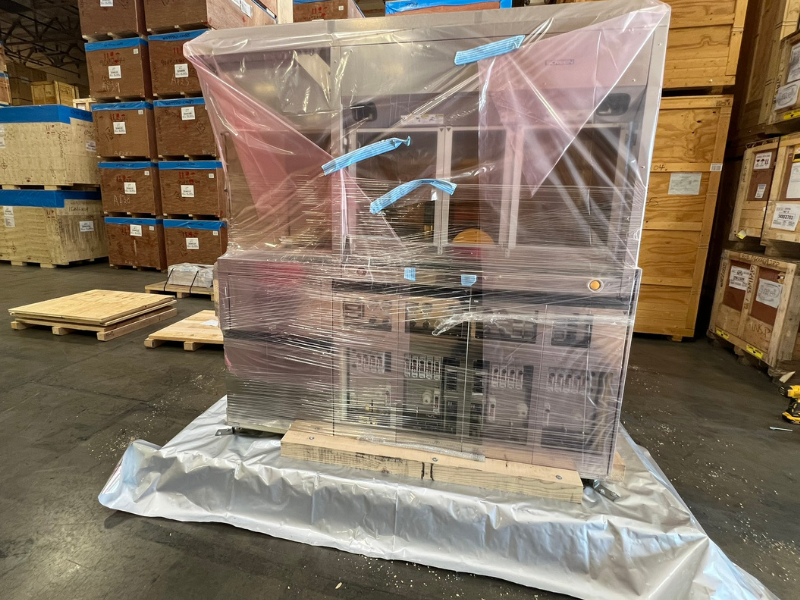
What Plant Relocation Services Actually Cover
A plant relocation service covers the engineering, packaging, transport coordination, and installation support required to move industrial equipment from one facility to another with minimal downtime and zero damage. Generic “moving companies” don’t do this work. The required capabilities span engineering (load calculation, rigging plans, crate design), regulatory compliance (ISPM-15, ITAR, hazmat, TSA), specialized packaging (vapor barrier, anti-static, shock-mount), and coordination across multiple trades – millwrights, electricians, calibration technicians, OEM service teams.
Crating Technology’s role within this ecosystem is the crating, packaging, and on-site protection layer. For full-scope relocations, Crating Technology integrates with rigging contractors, millwrights, and OEM teams. For projects where the equipment has been decommissioned and rigged by others, Crating Technology handles only the crating and packaging stage. Both models are common.
The five phases below describe the full scope. Different vendors handle different combinations.
The Five Phases of an Industrial Plant Relocation
Phase 1: Pre-Move Site Survey and Equipment Inventory
The first phase determines whether the rest of the project succeeds. Site survey covers three things: equipment audit, route audit, and risk assessment.
The equipment audit documents weight, dimensions, fragility profile, and any sensitivity flags (cleanroom, ITAR-restricted, calibration-sensitive, ESD-sensitive). For semiconductor fab tools, this includes the original installation footprint, utility connections, and any sub-component disassembly required for moves.
The route audit measures door clearances, ceiling heights, loading dock specs, freight elevator capacities, and turning radii at both origin and destination. Industrial equipment that fits through a door at the origin sometimes can’t fit through the destination’s loading dock. This is the kind of problem that’s catastrophic when discovered on move day and trivial when discovered during the survey.
Risk assessment identifies which equipment can move under power (rare), which needs partial disassembly, and which requires full disassembly to component level. For high-value items, the survey produces a documented condition baseline – photos, calibration records, operational state – that becomes the reference point for any post-move damage claims.
Phase 2: Engineering and Rigging Plan
Phase 2 turns the survey data into an engineering specification. Crate design happens here. So does rigging plan development, insurance documentation, and regulatory checklist completion.
Crating Technology’s SolidWorks and CAD design service drives the crate engineering. Each crate is modeled to the specific equipment’s weight, center of gravity, and fragility profile before fabrication begins. The model accounts for static and dynamic loads, panel stress, fastener pattern, and any internal cushioning, vapor barrier, or shock-mount integration required.
The rigging plan and the crate spec are interdependent. A crate engineered to be lifted from the top requires different bracing than one engineered to be lifted from the sides. A crate that will move on rollers requires different skid construction than one that will move on forklifts. These decisions happen in Phase 2, not Phase 3.
Phase 3: Decommissioning and On-Site Crating
Phase 3 is the operational core of the move. Decommissioning is the controlled shutdown of the equipment – power down, fluid drain, calibration documentation, sub-component removal. On-site crating is what Crating Technology specifically handles: building the crate around the equipment at the origin facility, rather than trying to move the equipment to a separate crating shop.
On-site crating matters when the equipment can’t be moved without protection (sensitive cleanroom tools, calibrated instruments, equipment too large for transport without disassembly) or when the timeline doesn’t allow a separate stop at a crating facility. Crating Technology crews build the crate, integrate vapor barrier or anti-static packaging as required, and complete the protective packaging at the source.
For high-value or environmentally-sensitive equipment, this phase also includes the application of:
- Vapor barrier packaging – sealed barrier liners with desiccants for moisture-sensitive electronics and metal components
- Anti-static packaging – ESD-safe materials for electronics manufacturing equipment
- Shockmount bases – vibration-isolating mounts for calibrated instruments and precision tools
Phase 4: Transport and Logistics
Transport varies with the destination and the equipment. Domestic moves in a single state typically use specialized truck transport. Cross-country moves use coordinated truck-rail-truck or air freight for time-critical equipment. International moves involve container loading, TSA-screened air freight (for AOG-style time pressure), or sea freight with ISPM-15 compliant export crates.
The logistics coordination function – Crating Technology’s logistics coordination service – manages the carrier handoffs, documentation, customs clearance for international shipments, and tracking. For multi-modal moves, this is where most timeline slips happen, and where strong coordination is the difference between an on-time install and a six-figure missed-deadline penalty.
Phase 5: Reinstallation and Commissioning Support
Phase 5 is the mirror of Phase 3. Equipment arrives at the destination, gets unpacked in the reverse sequence of how it was packed, and gets handed off to the OEM service team or in-house millwright crew for reinstallation. The crating vendor’s role is unpacking documentation, condition verification (matching the Phase 1 baseline), and coordinated handoff.
Some relocation projects include OEM-managed commissioning – calibration, alignment, trial runs – that happens after physical reinstallation. The crating vendor’s role usually ends at handoff, but the documentation produced during decommissioning often gets used during commissioning to verify that nothing changed during transit.
Special Considerations for Semiconductor Fab Moves
Semiconductor fab relocation is the most demanding subset of plant relocation work. The equipment is the most sensitive – photolithography tools, wafer-handling systems, EUV (extreme ultraviolet) lithography systems, deposition tools – and the cost of damage or miscalibration is among the highest in any industrial move.
Three things make fab moves different:
Cleanroom protocols. Equipment from a Class 100 or Class 1000 cleanroom can’t be exposed to ambient air without contamination risk. Anti-static packaging, sealed barrier liners, and controlled-environment transport are standard. Some moves require local cleanroom environments at both decommissioning and reinstallation sites.
Vibration sensitivity. Photolithography tools are designed to operate on isolated foundations because nanometer-scale features are sensitive to vibration measured in micro-G. Standard road transport routinely exceeds those tolerances. Shock-mount bases, recorded shock data (Shockwatch and similar), and route planning that avoids rough roads or rail crossings are part of the engineering.
Phoenix Silicon Desert geography. TSMC’s Fab 21 in North Phoenix, Intel’s Ocotillo campus in Chandler, and Microchip Technology’s Chandler operations create a regional concentration of fab equipment moves – both inbound (new tool installation) and outbound (tool returns to manufacturers in Asia, primarily Japan and Taiwan). Crating Technology operates in the local geography directly, which matters for projects where the Phoenix shop is the staging point between the origin facility and the destination port or air freight terminal.
For the deeper service overview, see Crating Technology‘s fab relocation service page and the semiconductor industry hub.

Special Considerations for Defense and Aerospace Moves
Defense and aerospace relocation work brings different requirements: regulatory compliance, chain-of-custody documentation, and Mil-Spec packaging standards.
ITAR (International Traffic in Arms Regulations) controls the export of defense articles and technical data. Equipment classified as ITAR-controlled requires documented chain of custody, U.S. person handling, and export licensing for any international transfer. The packaging vendor must comply with ITAR requirements as part of the supply chain. Reference: U.S. State Department Directorate of Defense Trade Controls.
DFARS (Defense Federal Acquisition Regulation Supplement) imposes additional requirements on suppliers to defense contractors, including cybersecurity (NIST SP 800-171) and supply chain risk management.
Mil-PRF-131L vapor barrier packaging is the defense standard for moisture-vapor-proof barrier bags used to protect sensitive equipment from corrosion during transit and storage. Crating Technology supports Mil-Spec work through a partnership with 3D Barrier Bags, which produces Mil-PRF-131L Class 1 compliant material. See Crating Technology‘s Mil-Spec service page.
TSA-screened air freight is required for any equipment moving via passenger aircraft. The TSA Certified Cargo Screening Program (CCSP) applies. Crating Technology’s TSA screening design service produces crates engineered for compliant screening – important because crates that can’t be cleared by standard screening methods get delayed at airports.
For the broader service overview, see the defense industry and aerospace pages.
Timeline and Cost Factors
Pricing varies enough across projects that publishing a price list would be misleading. The variables that drive cost:
- Equipment count and complexity. A single CNC machine moves differently than a 50-tool production line. Engineering scales nonlinearly with count.
- Distance and route mode. Truck-only is cheapest. Multi-modal (truck-rail-truck or truck-ocean-truck) adds coordination cost. Air freight adds significant cost but compresses timelines.
- Downtime tolerance. Operations that run 24/7 force compressed timelines, which require larger crews and parallel work – meaning higher costs. Phased moves (one production line at a time, with continued partial operation) cost less than full shutdowns.
- Regulatory layer. ITAR, hazmat, ISPM-15, TSA-screened, and DFARS each add documentation and process cost.
- Cleanroom or environmental requirements. Cleanroom-compatible decommissioning costs more than standard industrial decommissioning.
Timelines range from a few weeks for a single equipment line to 12+ months for a full multi-building campus relocation. Most semiconductor fab tool moves run 8–16 weeks from kickoff to commissioned-and-running at the destination.
Red Flags When Evaluating a Plant Relocation Vendor
Six warning signs that should drive a vendor change or scope revision:
- No engineering capability. A vendor that builds crates without SolidWorks or CAD modeling is guessing. For high-value equipment, that’s not acceptable.
- No relevant certifications. Look for ISPM-15 producer status, TSA CCSP certification, hazmat broker registration, and any industry-specific certifications (SEMI, IPC, ISO) relevant to the equipment being moved.
- Generic crate inventory. Vendors that pull a “standard” crate from inventory and adapt the cargo to fit are wrong for industrial work. The crate should be engineered to the equipment, not the reverse.
- No documented process for cleanroom or ITAR work. If the vendor can’t describe the protocol they use, they don’t have one.
- Single-point-of-failure staffing. A vendor that depends on one or two key people for critical decisions creates project risk. Look for documented processes and depth of bench.
- Vague answers on chain of custody. For ITAR, defense, or any equipment with regulatory tracking requirements, chain of custody must be documented and verifiable.

Frequently Asked Questions
What does a plant relocation service include?
A plant relocation service includes pre-move site survey and equipment inventory, engineering and rigging plan development, decommissioning and on-site crating, transport coordination, and reinstallation support. Specialized capabilities like cleanroom protocols, ITAR compliance, and vapor barrier packaging are added based on the equipment’s requirements.
How long does an industrial plant relocation take?
Timelines range from a few weeks for a single equipment line to 12+ months for a multi-building campus relocation. Semiconductor fab tool moves typically run 8–16 weeks from kickoff to commissioned operation at the destination.
What’s the difference between plant relocation and equipment moving?
Equipment moving is the physical transfer phase. Plant relocation includes engineering, decommissioning, packaging, transport coordination, regulatory compliance, and reinstallation support – the full controlled shutdown and restart of a productive asset.
Can plant relocation be done during business hours?
Phased relocations allow continued partial operation during the move. Full-shutdown relocations are common for cleanroom work and ITAR-restricted moves. The right choice depends on downtime tolerance and the regulatory layer.
How do you protect equipment during a plant move?
Protection comes from custom-engineered crates designed to the specific equipment’s weight, center of gravity, and fragility profile, plus vapor barrier packaging, anti-static materials, shock-mount bases, and on-site crating built around the equipment at the origin facility.
What is fab relocation?
Fab relocation is semiconductor fabrication facility equipment relocation – a specialized subset involving cleanroom-compatible decommissioning, vibration-isolated transport, and tool-specific handling protocols for photolithography, deposition, etch, and wafer-handling equipment.
Do plant relocation companies handle international moves?
The crating and packaging vendor must be ISPM-15 certified and able to coordinate TSA-screened air freight or container-loaded sea freight. Documentation for customs clearance, ITAR licensing (where applicable), and chain of custody is required.
A Final Note on Vendor Selection
Plant relocation is engineering work, not moving work. The vendors who succeed at it are the ones who treat the crating, packaging, and protective layer as a structural engineering problem rather than a packaging afterthought. The cost difference between an engineered relocation and a generic one is rarely more than 10–15% of total project cost. The cost difference between an engineered relocation and a damaged-equipment outcome is several orders of magnitude larger.
For Phoenix-area semiconductor fab moves, defense and aerospace facility transfers, or data center equipment relocation, request a site survey or call (602) 528-3628 to scope a project.


