

A wood shipping crate is a structural assembly engineered for a specific load, route, and risk profile – not a box with a lid. Most industrial buyers learn that distinction the hard way, after a damaged shipment, a customs rejection, or a freight claim that the carrier denies because the crate didn’t meet engineering specifications.
Crating Technology builds wood shipping crates from a Phoenix, Arizona facility for many industries including – semiconductor, defense, aerospace, data centers, automotive, food and beverage, oil and gas, healthcare, energy, and mining. Each industry has different load profiles, regulatory requirements, and failure modes. The right wood crate for a fab tool relocation looks nothing like the right crate for a piece of trade show A/V equipment.
This guide covers the five main wood crate types, how they’re engineered for load, when wood beats alternative materials, what ISPM-15 means for international shipments, and how to spec a crate that matches the actual shipment instead of a generic shipping budget. The audience: engineers, operations managers, and shipping coordinators evaluating wood crate options for industrial freight.
The structural difference between a wood crate and a wooden box matters more than most buyers realize. The U.S. Department of Agriculture’s Forest Products Laboratory publishes the Wood Crate Design Manual (Handbook 252), which defines a crate’s strength as rated with the top in place. A wooden box’s strength is rated without the top. That sounds technical until a forklift drops a 4,000-pound load onto a shipment and the difference becomes a six-figure freight claim.

What a Wood Shipping Crate Is (and Isn’t)
A wood shipping crate is a self-supporting six-sided structural container engineered to protect, support, and contain cargo during transit. The frame carries the load. The panels – solid lumber, plywood, OSB, or cleated panelboard – provide containment, weather protection, and impact resistance.
A pallet, by contrast, is a flat platform for forklift handling. It has no protective sides. A wooden box has thinner walls and depends on its lid for structural integrity, which means it loses much of its load rating if the lid is removed during transit. A corrugated container is rated by edge crush test and bursting strength, both of which fail well before wood under industrial loads.
The practical implication: a wood shipping crate is the right answer when the cargo’s weight, value, fragility, or route exceeds what a pallet, box, or corrugated container can handle. Below that threshold, simpler packaging is more cost-effective. Above it, wood crating starts paying for itself on the first shipment.
The Five Main Wood Shipping Crate Types
Here’s the high-level comparison before the detail:
| Type | Best For | Cost | Reusable | Weight |
|---|---|---|---|---|
| Closed crate | High-value, weather-exposed, multi-leg shipments | Higher | Sometimes | Higher |
| Open/skeleton crate | Heavy machine parts, ventilated cargo | Lower | Sometimes | Lower |
| Crate on skid | Heavy industrial equipment | Higher | Yes | Highest |
| Reusable knock-down crate | Trade shows, plant rotations, tooling | Highest upfront | 30+ trips | Variable |
| Heat-treated / ISPM-15 crate | International shipments | Premium | Yes (if undamaged) | Higher |
Closed Crate
A closed crate has fully enclosed plywood or solid lumber panels on all six sides. The construction protects against rain, dust, theft, and impact. It’s the default choice for high-value cargo, multi-leg journeys (truck → warehouse → ocean → truck), and equipment that can’t tolerate weather exposure.
The construction varies with the cargo. Industrial-grade closed crates use 1/2″ or 3/4″ plywood panels framed with 2×4 lumber and assembled with cement-coated sinker nails or screws. Higher-value shipments add 1×4 cleats around panel perimeters to prevent racking, corner-block assembly for rigidity, and internal blocking sized to the cargo.
Open / Skeleton Crate
An open crate uses slatted construction – vertical supports with horizontal slats spaced apart instead of full panels. The result is a structural frame with partial enclosure.
Open crates work for heavy machine parts that don’t need weather protection, ventilated cargo (anything that needs airflow during transit), and weight-sensitive air freight where every pound of crate adds to the shipping bill. Customs inspectors at international ports can also visually inspect open crates without breaking the seal, which speeds clearance for low-risk shipments.
The trade-off: less protection from impact, contamination, and environmental exposure. Open crates rarely make sense for shipments crossing climate boundaries or moving through multiple handling stages.
Crate on Skid
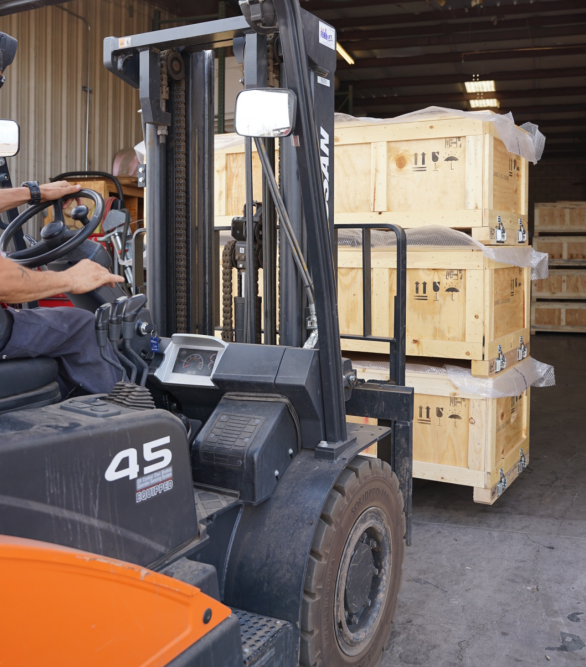
A crate on skid is a closed or open crate built on a forkliftable skid base – typically 4″ to 8″ of clearance under the cargo for forklift forks and pallet jacks. The skid is integrated into the crate’s structural design, not added afterward.
This is the right format for heavy industrial equipment: machine tools, generators, transformers, large pumps, fab tools. The skid lets the crate be moved without specialized rigging, which matters at every handoff between origin and destination. Equipment that must remain on its skid for installation (because the skid is engineered as part of the install footprint) gets the same construction approach. Crating Technology’s pallets and skids service covers this overlap directly.
Reusable / Knock-Down Crate
A reusable crate is built for repeated use. Hardware is the difference: bolted connections, draw-latches, hinges, and Klimps spring-wire fasteners replace nails. The crate disassembles cleanly for storage between uses and reassembles with hand tools – sometimes without tools at all.
Reusable wood crates make sense for trade show circuits (one display traveling to four to six shows per year), plant-to-plant tooling rotations, and any shipment that’s going to repeat. The upfront cost is higher than a single-trip crate. The economics break even somewhere between three and five round trips, depending on the freight cost saved by avoiding a new crate each cycle. Quality reusable crates routinely handle 30+ round trips before retirement.
Crating Technology’s reusable crate service uses hardware patterns matched to the cargo and use cycle.
Heat-Treated / ISPM-15 Crate
A heat-treated crate is built from lumber that has been heated to 56°C core temperature for at least 30 continuous minutes – the treatment standard set by the International Plant Protection Convention under ISPM-15 (International Standards for Phytosanitary Measures No. 15).
Heat treatment kills wood-boring pests that customs authorities at receiving countries are tasked with intercepting. The crate must be assembled from treated lumber by a registered, audited producer. The producer applies the IPPC stamp – the so-called “bug stamp” – to the finished crate.
ISPM-15 compliance is non-negotiable for international wood packaging. A non-compliant crate can be refused, fumigated at the shipper’s expense, or destroyed at the destination port. The full mechanics of compliance – what customs actually inspects, why repaired crates need re-treatment, and which countries enforce strictly – are covered separately in Crating Technology’s ISPM-15 service overview.

How a Wood Crate Is Engineered for Load
The difference between a crate that survives transit and a crate that doesn’t comes down to engineering – not craftsmanship. A crate built by a talented carpenter without a load calculation is a guess. A crate modeled in SolidWorks with the cargo’s weight, center of gravity, and fragility profile factored in is a load-rated structural assembly.
Crating Technology’s SolidWorks and CAD design service drives the engineering for high-value or fragile shipments. The model accounts for static load, dynamic load (the multiplier from forklift impact and over-the-road shock), bracing geometry, and panel loading. The fabrication crew builds to the model.
Lumber Grade and Wood Type
The frame lumber drives most of the load capacity. Most industrial crates use Southern yellow pine – a softwood that holds fasteners well, costs less than hardwood, and has consistent grading available from most lumberyards. Spruce and Douglas fir work for lighter loads.
Hardwoods like oak and maple show up in two scenarios: high-cycle reusable crates where wear resistance matters more than cost, and very heavy single-trip crates where the additional fastener-holding capacity of dense wood is worth the weight penalty.
The USDA’s Wood Crate Design Manual lists nail withdrawal values per wood species – a useful reference when specifying construction for an unusual load. The manual is freely available from the Forest Products Laboratory and remains the authoritative engineering reference for wood crate construction.
Fastener Pattern and Bracing
Cement-coated sinker nails are the industry standard for assembled crates. The cement coating increases withdrawal resistance, meaning the nail stays seated under vibration and shock load – exactly what happens during transit.
Screws (Robertson square-drive, typically) replace nails in reusable crates and in any crate where future disassembly is expected. Glue plus screw is stronger than glue plus nail under racking loads.
Bracing handles the loads the panels can’t. Diagonal bracing prevents racking – the parallelogram-deformation failure mode of any rectangular structure. Cross-bracing on the lid prevents top-load failure when crates are stacked. Internal blocking immobilizes the cargo against the crate walls so kinetic energy doesn’t transfer through the cargo into the crate during a drop.
Panel Materials
Panel material selection comes down to four factors: cost, weight, weather resistance, and fastener-holding capacity at edges.
Solid lumber panels (1×6 or 1×8 boards) handle abuse well but are heavy and can split at fastener points. Plywood is the most common panel material – Type III hardwood plywood per the USDA manual, in 1/4″, 3/8″, or 1/2″ thicknesses depending on load. OSB is cheaper than plywood and works for low-stakes domestic shipments, but it swells with moisture and its edges don’t hold fasteners as well as plywood. Cleated panelboard – a thin plywood face glued to a 1×4 lumber frame – is the lightweight option for air freight.
For most industrial closed crates, 1/2″ plywood with 1×4 cleats around the perimeter is the right balance.
When Wood Beats Steel, Plastic, or Corrugated
Wood isn’t always the right answer. For high-volume, low-value shipments – uniform consumer goods, parts shipped in bulk to repeat destinations – corrugated containers and plastic totes win on cost. For permanent equipment cases (server road cases, A/V cases) shipped a hundred-plus times per year, a roto-molded plastic case beats wood on durability per cycle.
Wood wins when:
- The cargo is irregular or oversized. Custom wood crates form to any shape. Molded plastic and steel cases come in fixed sizes, which forces the cargo to fit the case rather than the case fitting the cargo.
- The shipment is one-time or low-cycle. Steel and roto-molded plastic cases cost five to twenty times more than wood crates of equivalent capacity. The economics don’t break even until the case rotates many times.
- The cargo is heavy. A wood crate on a forkliftable skid handles loads (up to 10,000+ lbs) that steel cases can’t accommodate without becoming impractically expensive.
- The cargo needs custom internal protection. Wood crates accept vapor barrier liners, anti-static packaging, custom foam inserts, shock-mount bases, and desiccants without modification.
- The shipment is international. Heat-treated wood crates with the IPPC stamp clear customs in over 80 countries. Steel and plastic cases work too but typically cost more for equivalent strength.
- The crate needs to be repaired or modified in the field. A damaged wood crate can be repaired with a saw, fasteners, and replacement lumber. A damaged steel case needs a welder. A damaged molded plastic case is usually scrap.
ISPM-15 and Heat-Treated Requirements for International Shipping
ISPM-15 is the global phytosanitary standard for solid wood packaging used in international shipping. It’s enforced by over 80 member countries of the International Plant Protection Convention.
The mechanics: solid wood packaging thicker than 6mm must be heat-treated (HT) or methyl bromide-fumigated (MB), debarked, and stamped with the IPPC mark by a registered producer. The stamp identifies the country, the producer’s audit ID, and the treatment method. Plywood, OSB, and processed wood products are exempt from ISPM-15 because the manufacturing process already kills any pests.
Three things buyers commonly miss:
- “Heat-treated lumber” is not the same as “ISPM-15 certified crate.” The lumber has to come from a certified mill and the crate has to be assembled by a certified producer. Buying treated lumber and assembling the crate yourself doesn’t produce a compliant crate.
- Repaired crates need re-certification. If a stamped crate is repaired, modified, or has any non-treated component added (including dunnage), it loses its ISPM-15 status and must be re-stamped.
- The stamp must remain visible. Crates rejected at port often have the stamp covered by labels, banding, or facing inward. The customs inspector can’t certify what they can’t see.
Crating Technology operates as an ISPM-15 certified producer through a partnership with Timber Products Inspection, which handles the audit cycle that maintains certification. The full guide to export crating compliance lives at the ISPM-15 service page.
How to Spec a Wood Crate for Your Equipment
Most RFQ delays come from missing information, not missing capability. Here’s the spec checklist that produces an accurate quote on the first pass:
Step 1: Document the cargo.
- Weight (gross, including any sub-packaging)
- Outer dimensions (length × width × height)
- Center of gravity (especially for top-heavy or asymmetric equipment)
- Fragility profile (vibration sensitivity, ESD sensitivity, calibration sensitivity)
- Replacement value (for insurance and crate engineering economics)
Step 2: Define the route.
- Origin to destination
- Handling stages (truck, warehouse, ocean, air, rail, multi-modal)
- Climate exposure (humidity, temperature swings, salt air for ocean)
- Carrier(s) involved
Step 3: Choose the use cycle.
- One-time-use crate (dispose at destination – see the one-time-use crate service)
- Reusable crate (hardware-assembled, multi-cycle)
- Returnable crate (designed to ship back to origin)
Step 4: Identify regulatory layers.
- ISPM-15 for international destinations
- ITAR for defense-controlled equipment
- TSA-screened for air freight
- Hazmat classification if applicable
- Industry-specific requirements (cleanroom, pharmaceutical, food-grade)
Step 5: Engage a crating engineer. A SolidWorks-modeled crate is engineered to spec. A talented carpenter without a model is guessing. The cost difference is usually less than 10% of the total crate cost. The reliability difference is everything.
Crating Technology’s custom crate design service handles the engineering and fabrication from a single point of contact.
Frequently Asked Questions
What is a wood shipping crate?
A wood shipping crate is a self-supporting six-sided wood structural container engineered to protect, support, and contain cargo during transit. Strength is rated with the top in place – distinguishing a crate from a wooden box, which is rated without the top.
What’s the difference between a crate and a pallet?
A pallet is a flat platform for forklift handling. A crate has six sides and provides structural protection on all axes. A crate on skid combines both – a fully enclosed crate built on a forkliftable base.
How much weight can a wood shipping crate hold?
Capacity depends on lumber grade, fastener pattern, panel thickness, and engineering design. Standard industrial crates handle 500 to 10,000+ pounds. Engineered crates designed for fab tools and heavy machinery handle higher loads when modeled for the specific cargo.
Are wood shipping crates ISPM-15 compliant by default?
No. Compliance requires heat-treated or methyl-bromide-treated lumber, debarking, assembly by a registered producer, and the IPPC stamp on the finished crate. Untreated wood crates cannot ship internationally.
How long do wood shipping crates last?
One-time-use crates last a single shipment cycle. Reusable crates with hardware assembly (bolted, screwed, hinged) routinely handle 30+ round trips before retirement.
Can wood crates be reused?
Yes – when designed for reuse. Reusable crates use hardware-assembled construction (bolts, screws, draw-latches, Klimps fasteners) instead of nails, and include protective hardware to survive repeated handling.
What kind of wood is used for shipping crates?
Most industrial crates use Southern yellow pine for the structural frame. Hardwoods (oak, maple) appear in heavy-duty or high-cycle reusable crates. Panels are typically plywood, OSB, or cleated panelboard.
How do I get a custom wood crate built?
Provide equipment dimensions, weight, fragility profile, route, and any regulatory requirements (ISPM-15, ITAR, TSA-screened, hazmat). Crating Technology’s Phoenix shop builds crates engineered in SolidWorks before fabrication, with internal blocking, cushioning, and protective layers matched to the cargo.
A Final Note on Crate Selection
A wood shipping crate is a structural decision, not a packaging afterthought. The cost difference between an engineered crate and an under-spec’d crate is rarely more than a few hundred dollars per shipment. The cost difference between an engineered crate and a freight claim – for damaged equipment, customs rejection, or rejected insurance – is typically several orders of magnitude larger.
For shipments where weight, value, fragility, or route exceeds the threshold for simpler packaging, a wood crate engineered to spec is the right answer. For shipments that don’t, simpler packaging saves money.
Crating Technology builds wood shipping crates from a Phoenix, Arizona facility for industrial buyers across the United States and internationally – supporting semiconductor, aerospace, defense, and other industrial verticals. To get a quote on a custom crate engineered to specific equipment, request a quote or call (602) 528-3628.


