

When your operation depends on the safe delivery of high-value equipment, the crate is not a commodity. It is a risk control system.
For logistics managers and procurement teams, selecting a partner for custom shipping crates Phoenix should never be reduced to comparing line-item pricing. The quality of engineering, compliance knowledge, and field execution behind that crate determines whether your shipment installs smoothly or turns into an expensive damage claim.
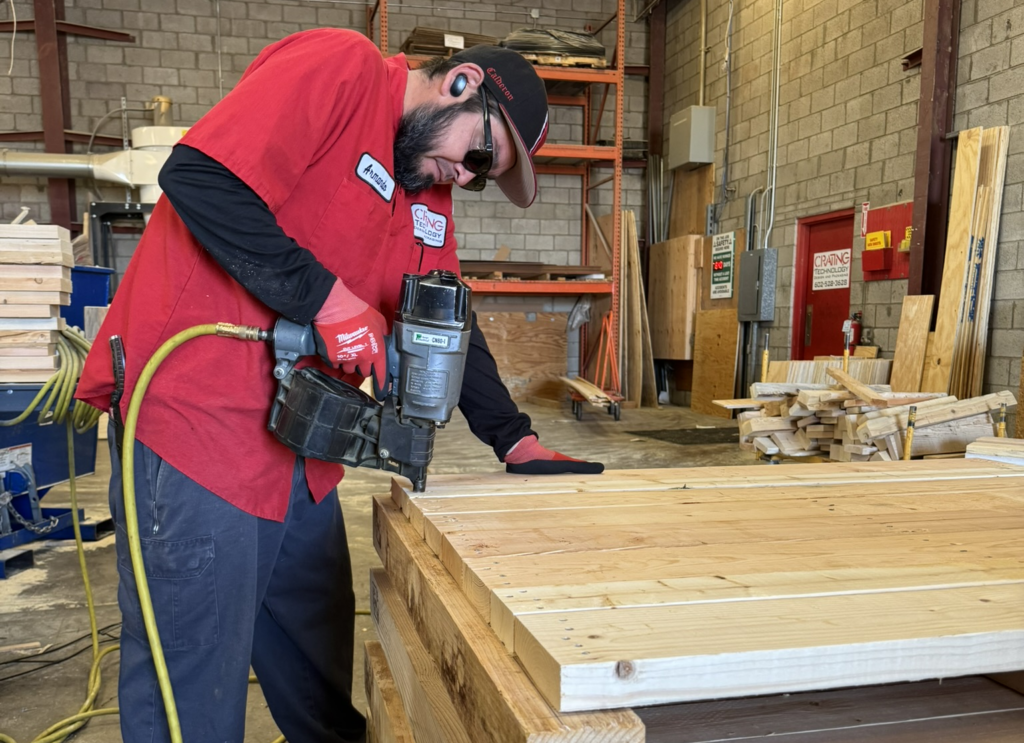
Here are five questions that separate qualified providers from basic box builders.
1. Do You Provide Engineered Design and CAD Modeling?
Crates fail when they are built around dimensions instead of physics.
A professional crating partner should evaluate weight, center of gravity, lift points, and transport forces before fabrication begins. Ask whether they use CAD design or SolidWorks modeling to engineer the structure around your specific asset.
Equipment that is top-heavy, vibration-sensitive, or asymmetrical requires more than reinforced lumber. It often requires internal bracing, load-bearing skid structures, or shockmount packing. If your equipment includes sensitive electronics or robotics, ask whether shock mitigation solutions are available to isolate the load from transit vibration. Engineering must always precede fabrication.
2. Are You Fully ISPM 15 Compliant for International Export?
If your shipment crosses borders, compliance is not optional.
Ask whether the company fabricates ISPM 15 compliant crating using heat-treated wood and applies the proper certification markings. Failure to meet these phytosanitary regulations can result in shipment quarantine, rejection, or destruction at the port of entry.
A qualified provider understands export compliant crating requirements and integrates them into the build process from the start. This is particularly critical for aerospace, defense, and high-value manufacturing equipment bound for international destinations. Export compliant crating is not an upgrade; it is a baseline requirement for global trade.
3. Do You Offer On-Site Crating Services?
Every additional handling step introduces risk.
Transporting fragile or oversized machinery to an off-site packaging facility may expose it to unnecessary vibration, lifting errors, or environmental exposure. Ask whether the company provides on-site crating services where the crate is built directly around the equipment at your facility.
On-site crating is especially important for semiconductor systems, biotech gear, and production equipment that cannot tolerate repeated movement. It allows technicians to anchor machinery to a custom skid, install cushioning, and apply protective wrapping in a controlled environment. For operations that cannot afford downtime, on-site execution minimizes disruption while improving shipment integrity.
4. What Moisture and Corrosion Protection Methods Do You Use?
Structural protection alone is rarely enough for long-haul transit.
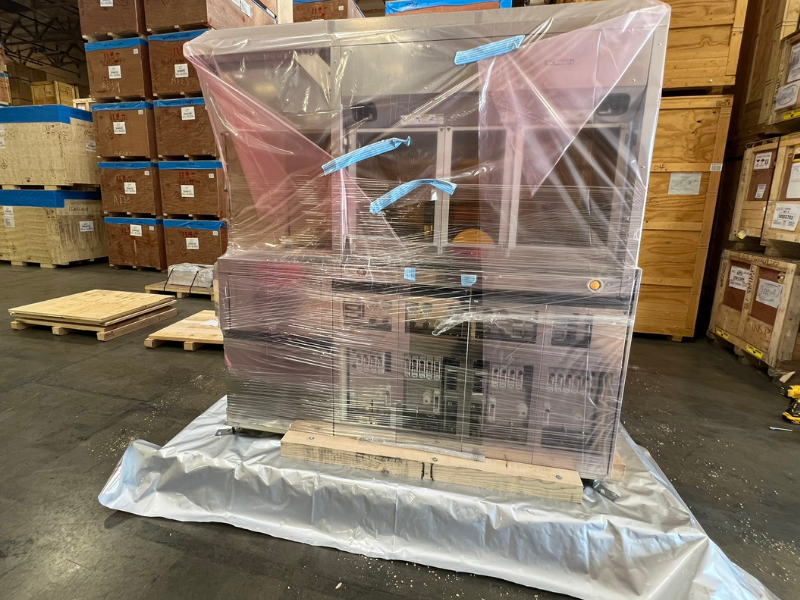
For ocean freight or extended storage, internal environmental control is critical. Ask what moisture mitigation methods are used, such as vapor barrier crating, sealed foil wrapping, and desiccant placement.
Corrosion damage often appears after delivery when installation begins, and electrical systems or precision surfaces are particularly vulnerable. A professional provider evaluates destination climate and transit duration before recommending a specific corrosion protection strategy.
5. Do You Have Industry-Specific Experience?
Not all equipment behaves the same under load.
Aerospace components, semiconductor tools, biotech equipment, and industrial equipment crating for heavy machinery each present different transport challenges. Ask for examples of similar projects within your sector, specifically regarding:
- High-value electronics and robotics protection.
- Hazardous materials such as regulated batteries.
- Large-format manufacturing systems and technology equipment shipping.
- Export-bound defense shipments and reusable crating systems.
A provider familiar with your industry will understand common failure points and logistical constraints long before the first board is cut.
The Bigger Picture: Engineering Over Assembly
Hiring a crating company is a risk management decision, not a simple purchasing transaction. A properly engineered crate protects more than equipment; it protects project timelines, installation schedules, and your company’s reputation.
The difference between successful delivery and a costly claim is determined during the design phase. For organizations preparing to ship high-value or sensitive equipment, a technical assessment is the most reliable way to control risk.
If you are evaluating your next shipment, request a consultation to review engineering requirements, compliance considerations, and on-site options before production begins.


